
Navigating Uncertainty: A Comprehensive Guide to ISO 31000 Risk Management
In today’s volatile business landscape, uncertainty is the only constant. Whether you are a small startup or a global enterprise, the ability to anticipate and manage risk is what separates market leaders from those who fall behind.
ISO 31000 provides the international gold standard for risk management. Rather than viewing risk as a purely negative force, this framework empowers organizations to treat uncertainty as a strategic tool for growth, resilience, and value creation.
What is ISO 31000?
ISO 31000 is a set of international guidelines designed to help organizations manage risks effectively. Unlike industry-specific standards, ISO 31000 is versatile—it can be applied to any sector, from finance and healthcare to manufacturing and tech.
The core philosophy of the standard is simple: Risk management should not be a standalone activity. Instead, it must be woven into the very fabric of an organization’s governance, strategy, and decision-making processes.
The Three Pillars of the ISO 31000 Model
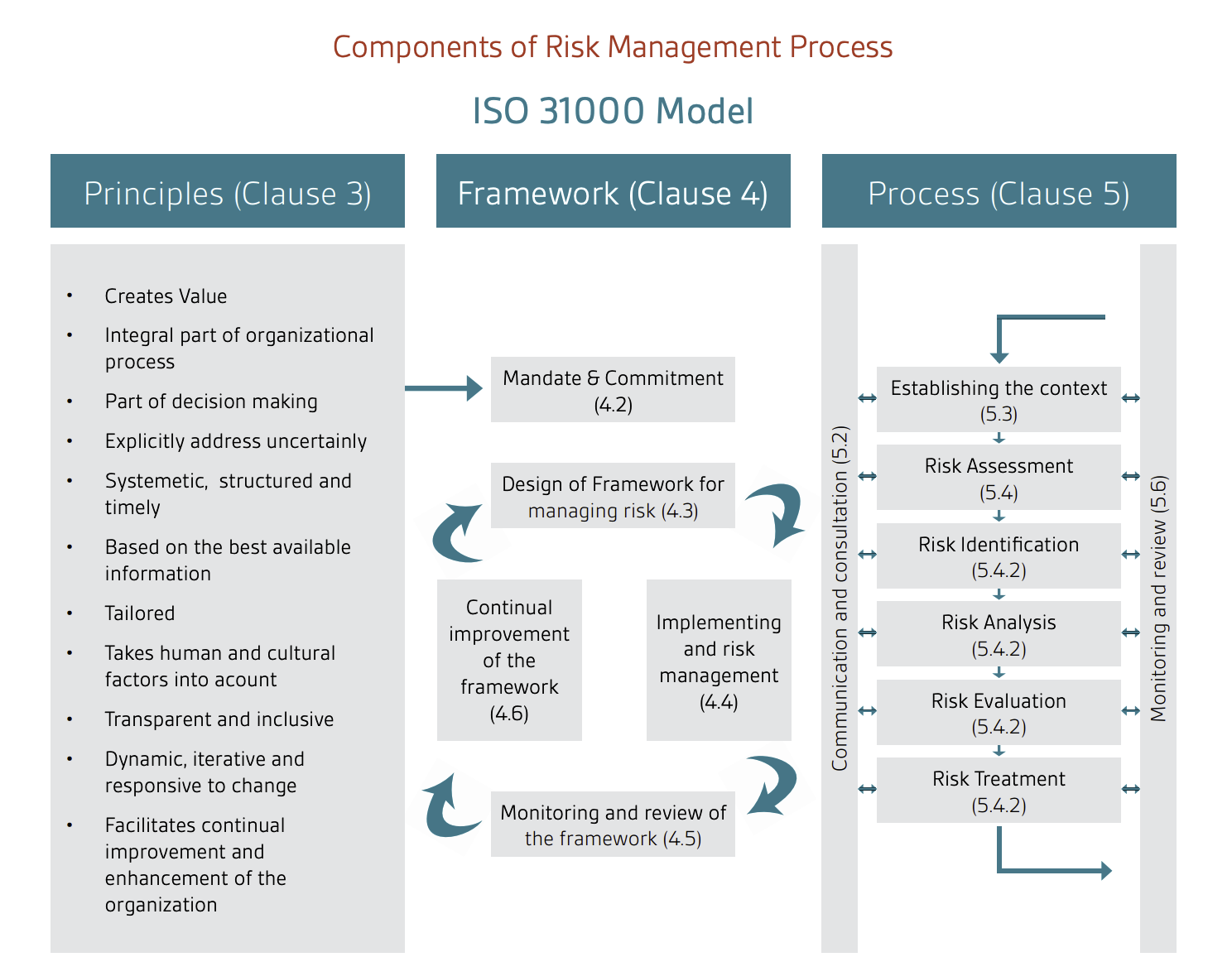
To master enterprise risk management, the BSI guidelines focus on three critical components: Principles, Framework, and Process.
1. Principles: The Foundation of Success
These are the fundamental truths that make risk management effective. Key principles include:
Value Creation: Risk management should explicitly protect and create value.
Integration: It must be an integral part of all organizational processes and decision-making.
Fact-Based: Strategies should be based on the best available information while remaining transparent and inclusive.
Dynamic: The system must be iterative and responsive to change.
2. Framework: Building the Structure
The framework ensures that risk management is supported by a continuous improvement loop:
Mandate & Commitment (4.2): Leadership must champion the risk culture.
Design & Implementation (4.3-4.4): Structuring the plan and putting it into action across the organization.
Monitoring & Continual Improvement (4.5-4.6): Constantly reviewing the framework’s performance to ensure it evolves with the business.
3. Process: The Method in Motion
This is the operational "heart" of the standard, visualized as a synchronized flow:
Communication and Consultation (5.2): Ongoing dialogue with stakeholders at every step.
Establishing Context (5.3): Defining the internal and external environment where risks occur.
Risk Assessment (5.4): A three-step sub-process involving Identification, Analysis, and Evaluation.
Risk Treatment (5.5): Implementing specific plans to address identified risks.
Monitoring and Review (5.6): Constant oversight to ensure treatments are working as intended.
The Umbrella Concept
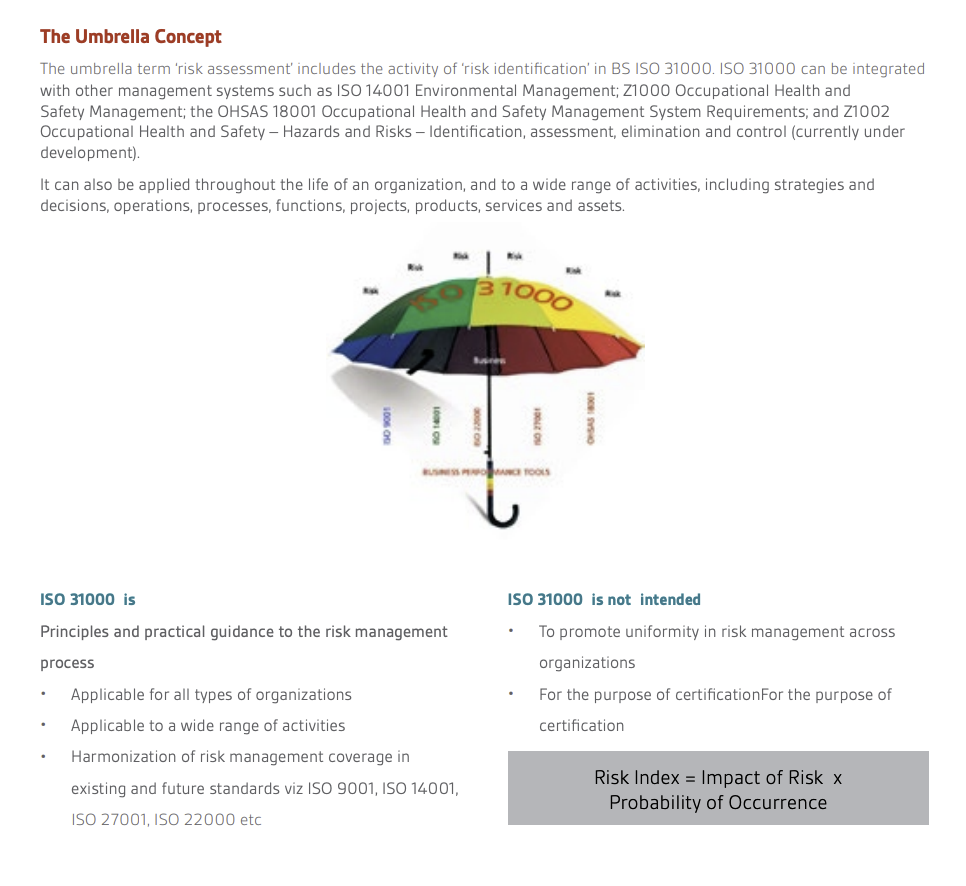
The ISO 31000 "Umbrella Concept"
ISO 31000 acts as a protective "umbrella" for an entire organization. Rather than operating in a silo, it harmonizes risk coverage across existing standards like ISO 9001 (Quality Management) and ISO 27001 (Information Security).
What ISO 31000 is:
Universal: Applicable to any organization and any activity, from strategic decisions to daily operations.
Practical: Offers guidance to streamline risk identification and mitigation.
What ISO 31000 is not:
It is not intended to force uniformity across different organizations; every business must adapt it to their needs.
It is not designed for certification purposes, but rather for internal improvement.
Key Formula: To quantify risk, organizations use the Risk Index:
Risk Index = Impact of Risk / times Probability of Occurrence
The Business and Institutional Benefits of ISO 31000
Adopting this standard isn't just about compliance; it's about gaining a competitive edge. Key benefits include:
Better Decision-Making: Use data-backed insights to choose the best path forward.
Increased Resilience: Bounce back faster from disruptions and market shifts.
Stakeholder Confidence: Build trust with investors, regulators, and customers by showing you have a handle on the future.
Proactive Management: Stop "firefighting" and start anticipating challenges before they become crises.